12 Pro Cycling Safety Tips That Could Save Your Life on the Road
Professional cyclists reduce their crash risk by an average of 60% through systematic safety protocols that recreational riders rarely adopt. Most cycling accidents stem from predictable scenarios: intersection conflicts, visibility failures, and group riding dynamics. The gap between amateur and pro-level safety isn’t talent or fitness, it’s the deliberate application of proven defensive riding techniques and equipment choices that World Tour teams treat as non-negotiable.
The difference becomes clear the moment you ride with someone who’s internalized professional safety habits. They scan intersections differently, position themselves with surgical precision in traffic, and communicate through the smallest gestures. These aren’t innate skills. They’re learned behaviors refined through team protocols, directeur sportif briefings, and the hard lessons of racing in tight pelotons at 50 kph.
What follows draws directly from those professional practices. We’ve distilled twelve safety principles that translate from the pro peloton to your daily training routes, Sunday group rides, and solo commutes. Some will challenge habits you’ve practiced for years. Others will feel like common sense you somehow never formalized. Each tip includes the reasoning behind it because understanding why professionals do something transforms a rule into a reflex.
You don’t need a team car following you to ride with professional-level safety awareness. You just need to know what the pros know and commit to making it automatic. Whether you’re logging base miles on rural roads or navigating urban traffic on your way to work, these evidence-based practices will change how you move through space on two wheels.
Why Pro Cycling Safety Measures Matter for Every Cyclist
Professional cycling has undergone a dramatic safety transformation over the past decade, driven by high-profile crashes, growing scientific understanding of head injuries, and mounting pressure from riders and teams. What started as voluntary team initiatives has evolved into mandated UCI safety protocols expansion that now govern everything from helmet standards to concussion assessment procedures. These changes weren’t born from bureaucratic whim, they emerged from real-world tragedies and near-misses in the peloton, where riders travel at 50+ mph in tightly packed groups.
The stakes in professional racing push teams to invest heavily in safety research, working with biomechanics experts, sports scientists, and equipment manufacturers to identify marginal gains in crash prevention and injury mitigation. WorldTour teams employ dedicated safety officers, conduct regular risk assessments of race routes, and maintain detailed incident logs that inform training protocols. This isn’t theater, it’s survival. When your livelihood depends on staying healthy through a grueling season, you adopt practices that actually work.
Here’s the crucial bit: these protocols aren’t designed for superhuman athletes with different physics. Professional cyclists crash at higher speeds, yes, but the fundamental mechanics of losing control, the importance of visibility, and the vulnerability of the human body remain identical whether you’re racing Paris-Roubaix or commuting to work. The difference is that pros have systematized their approach to managing these risks, turning safety from a vague concept into specific, repeatable behaviors.
The knowledge gap between professional and recreational cyclists has historically been vast, but it doesn’t need to be. The same descending position that helps Tadej Pogačar maintain control on Alpine passes works equally well on your local hill. The communication signals used in the peloton prevent crashes in weekend group rides. You don’t need a team car following you to benefit from practices developed at cycling’s highest level, you just need to know what they are and how to apply them.
What Makes a Safety Tip ‘Pro-Level’? Selection Criteria
Not all cycling safety advice is created equal. Generic tips often recycle the same basic mantras without explaining the rationale or offering actionable detail. The tips in this article, however, come from a different source: the professional cycling world, where safety protocols are tested at speeds exceeding 80 km/h and refined through decades of real-world experience.
The selection process for these 12 tips involved four key criteria:
- Evidence-based practices documented in professional team training protocols and medical research
- Input from team doctors, sports scientists, and performance coaches who work directly with WorldTour athletes
- Proven effectiveness in competitive scenarios where mistakes have immediate, serious consequences
- Direct applicability to everyday riding without requiring professional-level fitness or specialized equipment
What separates these recommendations from typical safety lists is their grounding in actual professional practice. Pro teams don’t implement safety measures because they sound good in theory. They adopt them because crashes cost races, end careers, and occasionally threaten lives. When a WorldTour team doctor insists on a particular helmet standard or a directeur sportif drills communication signals into riders, those decisions reflect hard-won lessons from the peloton.
Each tip included here has been tested at the highest level of the sport and adapted for cyclists who ride solo, in recreational groups, or during commutes. The focus is on techniques you can implement immediately, regardless of your fitness level. You won’t find vague suggestions to “stay alert” or “be careful.” Instead, you’ll get specific protocols with clear reasoning, borrowed from teams that have refined safety into both an art and a science.
12 Essential Pro Cycling Safety Tips
1. Master the Art of Descending Position
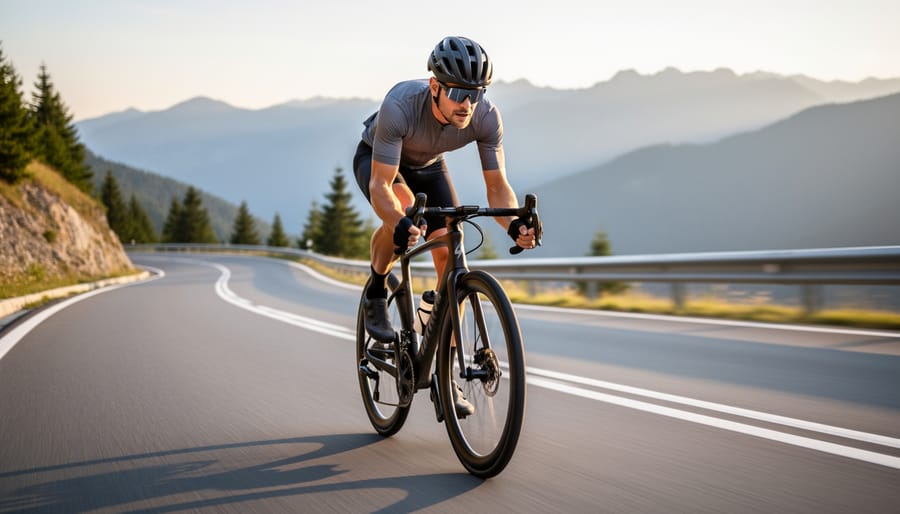
Descending at speed separates confident cyclists from cautious ones, and the difference often comes down to body position. Professional riders drop their center of gravity by moving their hips back on the saddle and lowering their chest toward the handlebars, creating a stable platform that resists being thrown forward during braking. Your weight should favor the rear wheel slightly, about 60/40, which prevents the front from washing out on loose surfaces while maintaining steering control.
Grip the drops with bent elbows acting as natural shock absorbers. Stiff arms transmit every road imperfection directly to your shoulders and reduce your ability to make quick steering corrections. Keep your knees and elbows slightly bent and relaxed, allowing your body to move with the bike rather than fighting it.
For brake modulation, think progressive pressure rather than grabbing. Feather both brakes before corners, scrubbing speed early so you’re not braking hard mid-turn. The front brake provides 70% of your stopping power, but apply it smoothly to avoid lifting the rear wheel.
2. Implement the ‘Look Ahead’ Protocol
Professional cyclists train their vision to work 10-20 seconds ahead of their current position, a discipline that transforms reactive riding into proactive hazard avoidance. This scanning protocol isn’t about staring at the horizon; it’s a systematic technique of sweeping your gaze from the road immediately ahead to points 50-100 meters down the route, then back again in a continuous loop.
Team coaches teach riders to identify “decision points”, areas where road conditions change, traffic merges, or surfaces deteriorate. By spotting these zones early, you gain crucial seconds to adjust speed, change position, or prepare an exit strategy. On descents, pros focus on corner exits while still mid-turn, allowing them to plan their line through the next curve.
The mental shift is profound: you’re no longer just reacting to what’s in front of your wheel. You’re reading the road like a route map, processing information that lets you ride smoother, brake less abruptly, and avoid last-second swerves that destabilize your bike or surprise other riders.
3. Use Communication Signals Religiously
The peloton relies on a sophisticated system of hand signals and verbal warnings that keeps dozens of riders moving safely at high speeds. When a pro cyclist spots gravel, a pothole, or debris, they immediately point at it while shouting “gravel left” or “hole right”, ensuring riders behind have time to react. This same discipline transforms group rides from risky drafting exercises into coordinated, safer experiences.
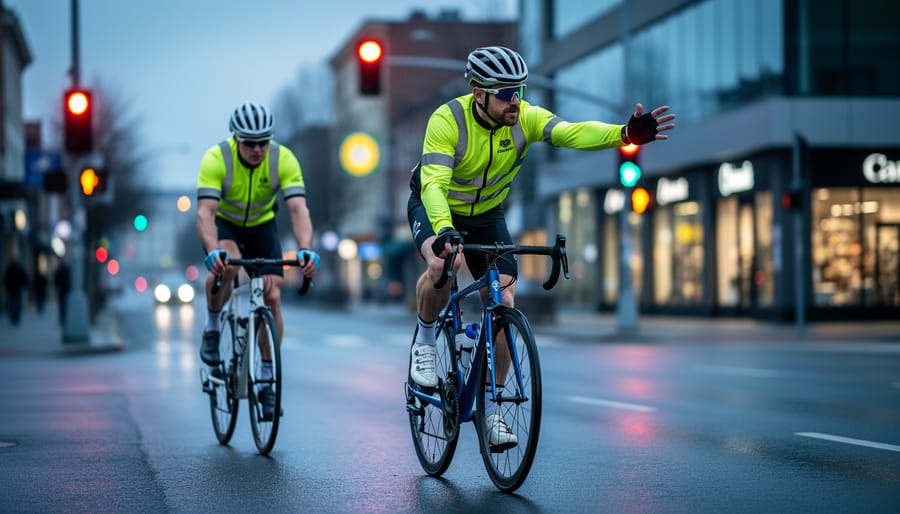
Master the essential signals: pointing down at road hazards, extending your left or right arm for turns, raising a hand overhead to signal stopping, and waving behind your back to indicate riders should move around you. Verbal calls work best when they’re specific and directional: “car back,” “slowing,” or “clear” at intersections.
The critical principle? Signal early and consistently, even if you think others see the hazard. Pro teams drill these communications because a single unreported obstacle can trigger a crash affecting twenty riders. On your group rides, this means calling out hazards every time, not just when they seem dangerous to you. The rider three positions back, looking at a wheel rather than the road, depends on your eyes and voice.
4. Adopt Team-Level Bike Maintenance Schedules
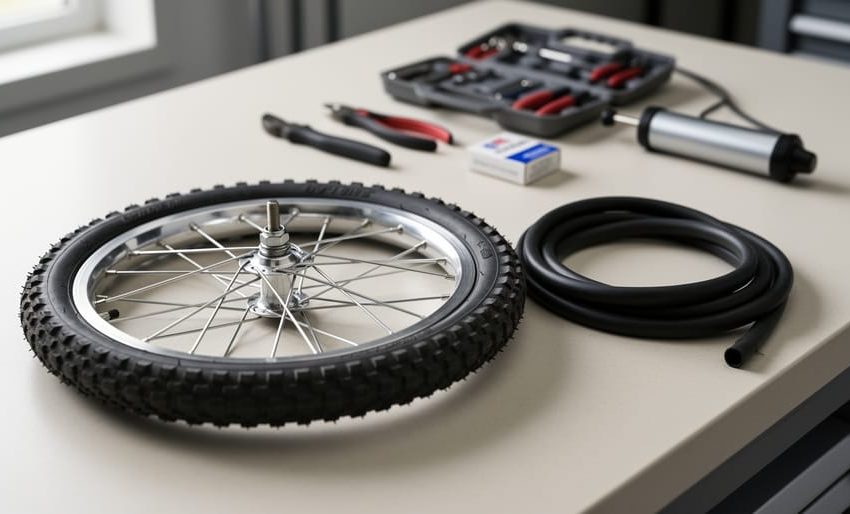
Professional cycling teams don’t leave mechanical safety to chance. Their mechanics perform systematic checks before every ride, and you should too. Start with the “M-check” protocol: beginning at the front wheel, inspect your bike in an M-pattern covering both wheels, brakes, drivetrain, and frame. Before each ride, verify that wheels are securely fastened, tires are properly inflated, brakes engage smoothly, and the chain runs cleanly through all gears.
Pro teams also follow strict maintenance intervals based on mileage rather than guesswork. Clean and lubricate your chain every 100-150 miles. Replace brake pads when the grooves disappear. Inspect cables monthly for fraying. Check tire tread regularly and replace tires showing cuts or worn casing.
The critical difference between recreational and professional maintenance isn’t complexity, it’s consistency. Set calendar reminders for monthly detailed inspections covering headset tightness, bottom bracket play, and spoke tension. A loose headset or worn brake cable can cause crashes just as easily on your local loop as in the Tour de France.

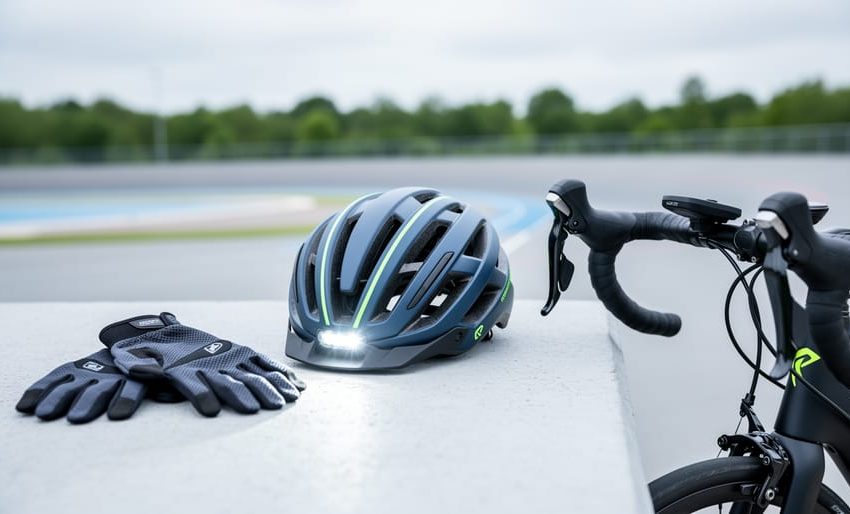
5. Wear Properly Fitted, Current-Standard Helmets
Your helmet is your last line of defense in a crash, but only if it meets modern standards and fits correctly. Professional teams have moved beyond basic foam shells to technologies like MIPS (Multi-directional Impact Protection System) and WaveCel, which address rotational forces that cause many traumatic brain injuries. These systems work by allowing a sliding layer or crumple zone that reduces the angular acceleration your brain experiences during an angled impact.
Fit matters as much as technology. Pro team fitters follow a strict protocol: the helmet should sit level on your head, about two finger-widths above your eyebrows, with straps forming a V beneath each ear and a snug but comfortable chin strap. You should be able to shake your head without the helmet shifting. If you can fit more than two fingers between the strap and your chin, tighten it.
Replace your helmet immediately after any crash involving head contact, even if you see no visible damage. The foam compresses during impact and loses protective capacity. Also replace helmets every five years regardless of crashes, as UV exposure and materials degradation reduce effectiveness over time.
6. Practice Controlled Braking Techniques
Professional cyclists train braking technique as deliberately as they train climbing or sprinting, because catastrophic crashes often stem from improper brake use rather than equipment failure. Understanding how to modulate your brakes transforms them from on-off switches into precision instruments.
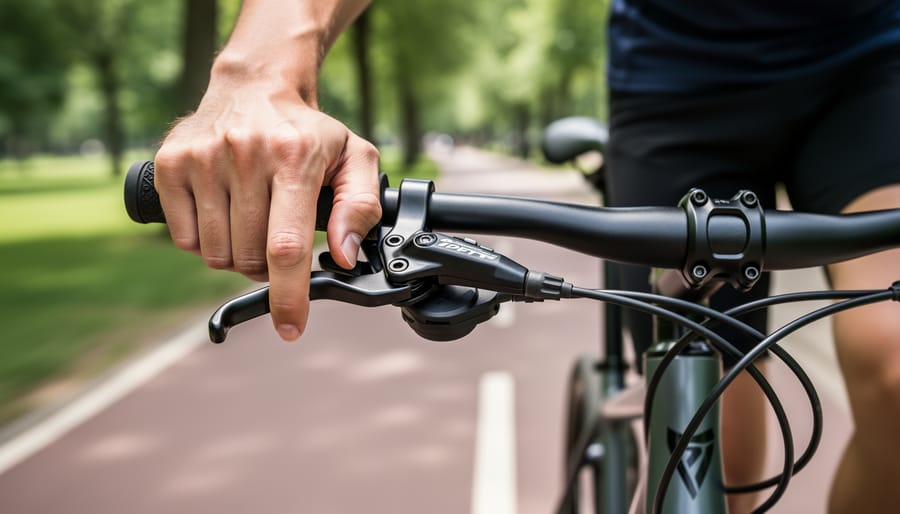
The fundamental principle: your front brake provides 70-80% of stopping power, but improper use sends you over the handlebars. Start every braking event with gentle rear brake pressure, then progressively add front brake while shifting your weight backward. This weight transfer is crucial, as you brake, momentum pushes you forward, so countering it by moving your hips back keeps your rear wheel grounded and maintains control.
Practice progressive squeeze rather than grabbing. Pro mechanics often describe proper braking as “squeezing a sponge”, gradual, controlled pressure that loads the brake pads without locking the wheel. In wet conditions, reduce front brake reliance to 60% and start braking earlier.
Set up emergency braking drills in safe environments: mark a braking zone, approach at speed, and practice stopping without skidding. Professional teams run these drills monthly, measuring stopping distances and refining technique until hard braking becomes muscle memory rather than panic response.
7. Maximize Visibility with Strategic Lighting and Clothing
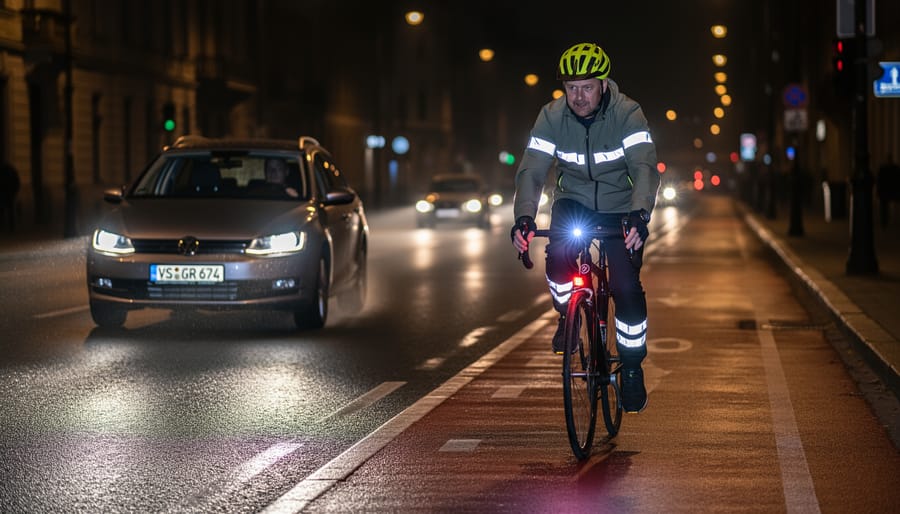
Visibility isn’t just a nighttime concern, pros run lights 24/7 because daytime collisions account for the majority of cycling accidents. Research shows flashing rear lights reduce your crash risk by 33% even in broad daylight, which is why WorldTour teams mandate them for training rides regardless of conditions.
Place your rear light at eye level for motorists, not hidden under your saddle. Front lights should flash in daylight but switch to steady beam at night to avoid disorienting other cyclists. For clothing, fluorescent yellow-green outperforms all other colors in daylight visibility tests, while retroreflective strips work best at night, that’s why pro team kits combine both.
Position reflective elements on moving parts: ankles, knees, and arms catch driver attention 2.5 times faster than static torso placement. Avoid all-black kit unless you’re adding significant lighting and reflective details. Your goal is to be seen from 500 meters in all conditions, the distance a car traveling at highway speed needs to react safely.
8. Learn Proper Group Riding Etiquette and Positioning
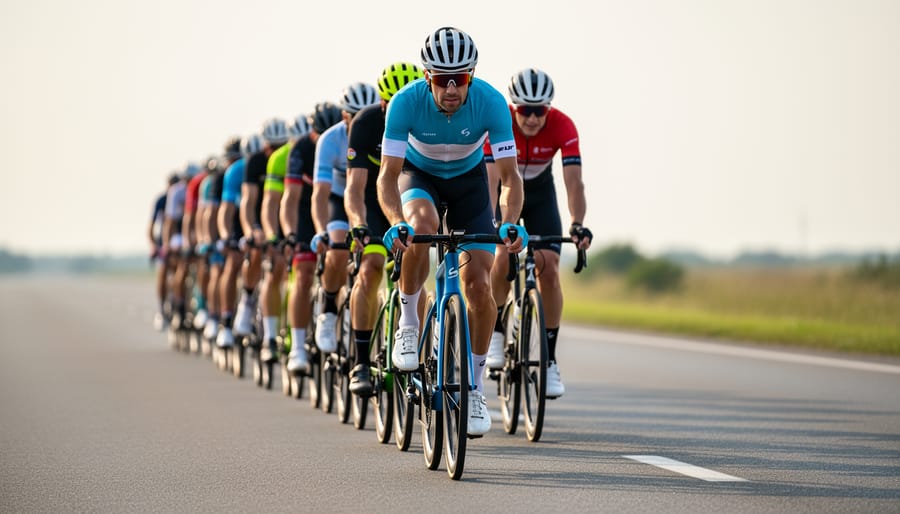
Group riding amplifies both the efficiency and the risk of cycling. In the professional peloton, crashes often cascade through the pack because one rider’s mistake affects dozens. The difference between a safe group ride and a dangerous one comes down to predictability.
Never overlap wheels. Keep your front wheel behind and slightly to the side of the rider ahead. If they swerve or brake suddenly, an overlapped wheel will almost certainly cause you to crash. Pros maintain a bike length when learning to draft, gradually closing the gap as confidence builds.
Ride a straight, steady line. Sudden movements, erratic braking, or weaving forces everyone behind you to react. In a paceline, smooth is safe. Signal every hazard, pothole, and turn with clear hand gestures or verbal calls. Point out glass, debris, or parked cars well before the group reaches them.
When pulling off the front, don’t slow down abruptly. Ease to the side and let your momentum carry you back through the line. Match the group’s pace when rejoining rather than forcing others to adjust to you.
9. Carry Emergency Identification and Medical Information
Even the most safety-conscious cyclist can find themselves in an accident, and those critical first minutes can determine outcomes. Professional cycling teams maintain rigorous emergency identification systems, not because they expect crashes, but because preparation saves lives when seconds matter.
Team doctors insist riders carry ICE information in at least two locations: jersey pockets and helmet stickers. Road ID bracelets remain the gold standard, waterproof, visible to first responders, and impossible to separate from your body during impact. They display blood type, allergies, emergency contacts, and critical conditions like diabetes or heart issues.
Your smartphone offers backup, but phones get damaged or flung away in crashes. Enable your phone’s medical ID feature (accessible from the lock screen), but never rely on it exclusively. Slip a laminated card with emergency contacts and medical details into your saddlebag alongside your insurance information.
Pro teams also use helmet-mounted QR codes that link to comprehensive medical profiles. Services like ICEdot provide stickers that first responders can scan for instant access to your complete medical history, current medications, and designated contacts. This redundancy ensures someone can advocate for your care even if you’re unconscious.
10. Master Cornering Techniques for Different Conditions
Cornering separates confident cyclists from tentative ones, and mastering this skill across different conditions can prevent crashes that often occur when riders panic mid-turn. Professional cyclists practice cornering techniques until they become automatic, allowing them to navigate curves safely even when fatigued or in adverse conditions.
The fundamental technique starts before you enter the turn. Look through the corner to where you want to exit, not at the obstacles you’re trying to avoid. Your bike follows your eyes. As you lean into the turn, keep your inside pedal up at the 12 o’clock position to prevent pedal strike. Apply pressure through your outside leg, pushing down through the pedal and into the bike. This creates a stable platform and allows you to weight the outside tire for maximum grip.
In wet conditions, reduce your speed more than feels necessary before the turn. Water reduces tire traction by up to 30%, and braking mid-corner on wet pavement can break traction instantly. Widen your line to make the turn more gradual, and stay more upright rather than leaning aggressively.
On gravel or loose surfaces, the technique shifts. Sit further back on the saddle, allow the front wheel to drift slightly if needed, and commit to your line without sudden movements. Pros describe it as “trusting the drift.”
11. Understand and Respect Traffic Patterns
Professionals treat traffic like a tactical element of their training environment, and you should too. The safest road position isn’t always the edge, it’s often the center of the right lane where you’re most visible and can claim your space. This forces drivers to fully commit to passing rather than squeezing by dangerously close.
At intersections, position yourself where turning drivers can see you. Never squeeze up the right side of vehicles that might turn across your path. When approaching stop signs or lights, make eye contact with drivers or assume they haven’t seen you. Adopt what pros call “defensive riding”: ride as if every car might do the unexpected thing. Take the lane when necessary for safety, signal clearly, and never rely on having the right-of-way to protect you. Your vulnerability demands you ride assertively enough to be seen but defensively enough to survive others’ mistakes.
12. Prepare for Weather and Road Condition Changes
Professional teams don’t just check the weather, they make data-driven decisions about tire pressure, clothing layers, and whether to ride at all. Adopt this systematic approach to weather preparedness.
Start your pre-ride routine 12-24 hours before departure. Check not just current conditions but hourly forecasts, paying particular attention to wind speed, precipitation timing, and temperature trends. Pro teams use a simple rule: winds above 25 mph, temperatures below freezing with wet roads, or active thunderstorms within 10 miles mean training rides get moved indoors.
Tire pressure matters more than most cyclists realize. Drop pressure 5-10 psi for wet conditions to increase contact patch and improve traction. WorldTour mechanics make these adjustments before every stage based on conditions.
Layer clothing using the “slightly cool at start” principle. You should feel just a touch cold in the first five minutes, your body will generate heat quickly. Carry a lightweight rain shell when there’s any precipitation chance above 30 percent.
Know your limits. If conditions feel sketchy during your assessment, they’ll feel worse 20 miles from home.
Putting It All Together: Your Safety Action Plan
Transforming these 12 safety tips from knowledge into habit requires a strategic approach. Rather than attempting everything at once, build your safety foundation in phases.
Start with the fundamentals this week. Ensure your helmet fits properly and meets current standards, establish a pre-ride bike check routine, and commit to using hand signals and verbal communication on every ride. These three create an immediate safety baseline without requiring new skills.
Over the next month, tackle the mechanical techniques. Dedicate a few rides to practicing controlled braking in a safe environment, an empty parking lot works perfectly. Focus on one cornering technique per ride until the inside-pedal-up position becomes automatic. Run descending drills on familiar hills where you can experiment with body positioning without worrying about traffic.
The following month, refine your awareness and visibility. Practice the look-ahead protocol consciously until scanning 10-20 seconds ahead becomes second nature. Upgrade your lighting setup and test different configurations. If you ride with groups, observe experienced riders’ positioning and gradually apply peloton etiquette principles.
Here’s the critical insight from professional cycling: safety isn’t a destination, it’s a continuous practice. Pro teams review and update their safety protocols constantly, and you should too. After every ride, take 30 seconds to reflect on one safety aspect, a near-miss avoided, a technique that worked well, or something to improve.
Weather and road conditions change, your routes evolve, and your skills develop. Revisit these tips quarterly, especially before seasonal transitions. What worked on dry summer roads needs adjustment when autumn leaves coat the pavement.
Most importantly, engage with your cycling community. Share what you’ve learned, ask questions about techniques you’re struggling with, and learn from others’ experiences. The peloton’s collective wisdom keeps everyone safer, your local riding group deserves that same collaborative approach to safety.
Common Questions About Cycling Safety
How often should I replace my cycling helmet?
Replace your helmet every 3-5 years even without crashes, as UV exposure and daily wear degrade the protective foam. After any significant impact, even if there’s no visible damage, replace it immediately since the internal structure may be compromised.
Which safety tips should beginners prioritize first?
Start with helmet fit and bike maintenance checks, then master controlled braking and basic visibility strategies. Once these fundamentals become automatic, progress to group riding etiquette and advanced techniques like cornering and descending position.
Are daytime running lights really necessary for road cycling?
Yes, research consistently shows that daytime running lights significantly increase driver detection distance, giving motorists more time to react. Front and rear lights in flash mode during daylight hours have become standard practice in professional cycling for this reason.
How can I practice advanced skills like descending without putting myself at risk?
Find a quiet, low-traffic descent with good visibility and practice during off-peak hours. Start well below your comfort speed, focusing on one technique element at a time, position first, then braking modulation, then line selection, before gradually increasing pace as confidence builds.
These questions reflect what most cyclists wonder when they’re serious about improving their safety practices. The answers from professional cycling aren’t complicated, but they do require commitment to building habits over time.
Remember that safety isn’t a destination where you tick every box and call it done. Conditions change, your skills evolve, and new research emerges. What matters is maintaining the mindset that every ride is an opportunity to refine your approach. The pros treat safety as part of their craft, not a chore, and that attitude shift makes all the difference in how consistently you apply these principles.
items
1. Master the Art of Descending Position – Control your bike at speed through proper weight distribution and brake modulation
2. Implement the ‘Look Ahead’ Protocol – Scan 10-20 seconds ahead to identify hazards before they become critical
3. Use Communication Signals Religiously – Alert other riders to hazards, turns, and pace changes with clear hand and verbal signals
4. Adopt Team-Level Bike Maintenance Schedules – Follow systematic pre-ride checks and maintenance intervals
5. Wear Properly Fitted, Current-Standard Helmets – Ensure your helmet uses modern safety technology and fits correctly
6. Practice Controlled Braking Techniques – Master front-rear brake balance and emergency stopping without skidding
7. Maximize Visibility with Strategic Lighting and Clothing – Make yourself seen with daytime lights and high-contrast clothing
8. Learn Proper Group Riding Etiquette and Positioning – Ride predictably in pacelines and avoid dangerous wheel overlap
9. Carry Emergency Identification and Medical Information – Have ICE contacts and medical details accessible in emergencies
10. Master Cornering Techniques for Different Conditions – Navigate turns safely on dry, wet, and loose surfaces
11. Understand and Respect Traffic Patterns – Position yourself defensively and navigate intersections with awareness
12. Prepare for Weather and Road Condition Changes – Adjust equipment and riding approach based on conditions